Low volume, heavy print
- Typical work
- A 14 piece welded frame, 3 sheets of print, 40 dimensions
- Where cost hides
- The fixture and the deburr nobody put a line against
- Priced from
- The last frame you built with the same joint count
Proprietary software by Ionio
Built for discrete manufacturing
Quoting system for discrete manufacturing
It reads the package as it actually arrived, breaks the part into operations, and prices every line from jobs you have already run. A week of work, signed off before the end of the day.
Book a demoThe cost of answering late
The ones that expire are the complicated ones with the most money attached.
New contract revenue, annual · Illustrative at a $22,000 average award
Most tools estimate what a part ought to cost from its geometry. This prices what it did cost, on your machines, on the job that ran closest to it.
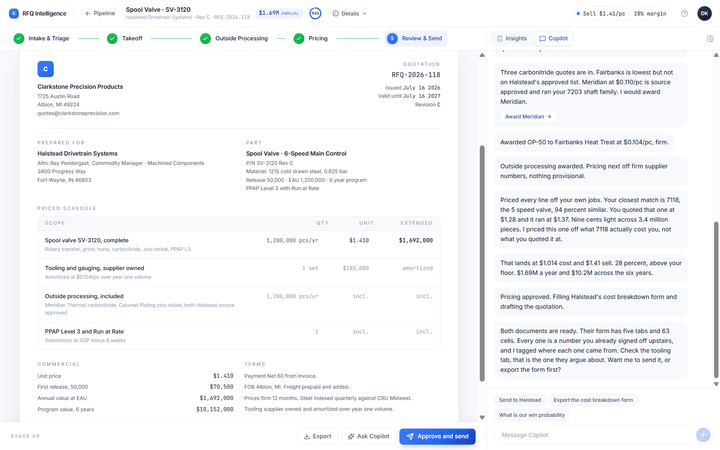
This quote was priced from what that job cost you, not from what you sold it for.
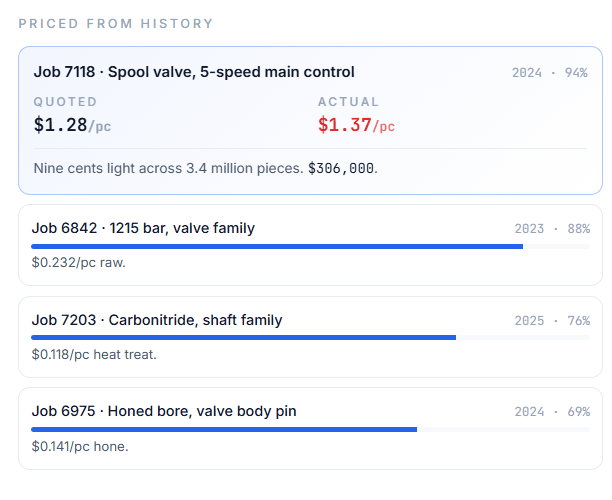
Every priced line names the job it came from
The same inbox carries 3 very different problems, and each one is priced from a different place in your history.
It moves between a sales head, an estimator and a specialist, and waits on a desk between every pair of hands. Then a revision lands and half of it gets done twice.
| Approach | Upfront | Time to live | Where it breaks |
|---|---|---|---|
| ApproachThe master spreadsheet | UpfrontLow | Time to liveDays | Where it breaksOne formula breaks quietly and you find out on a quote |
| ApproachPaperless, Sectura, aPriori | UpfrontHigh licence | Time to liveMonths | Where it breaksPriced for clean CAD, not the package in your inbox |
| ApproachThe in-house build | Upfront$100k to $250k | Time to live6 to 12 months | Where it breaksNeeds a software team you were never built to hold |
| ApproachA configured system | UpfrontFree pilot | Time to live7 to 10 days | Where it breaksBuilt for the package as it actually arrives |
An estimator trusts a system when they can see why it landed on a number and argue with it before the price goes out.
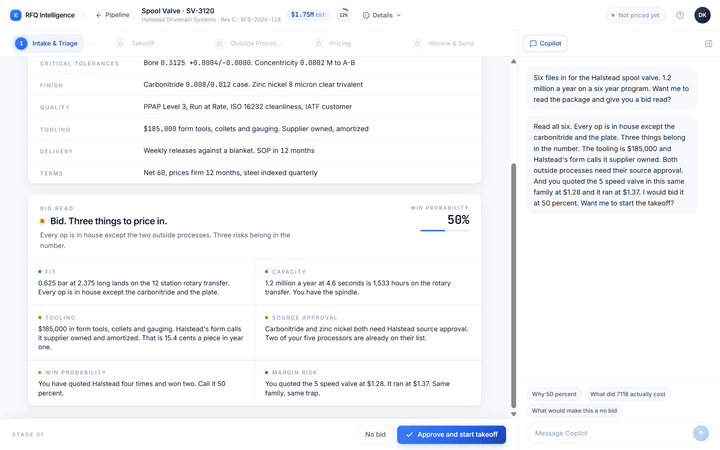
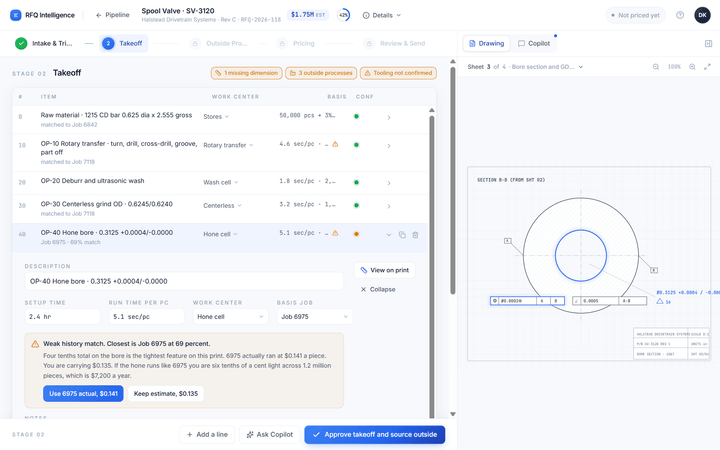
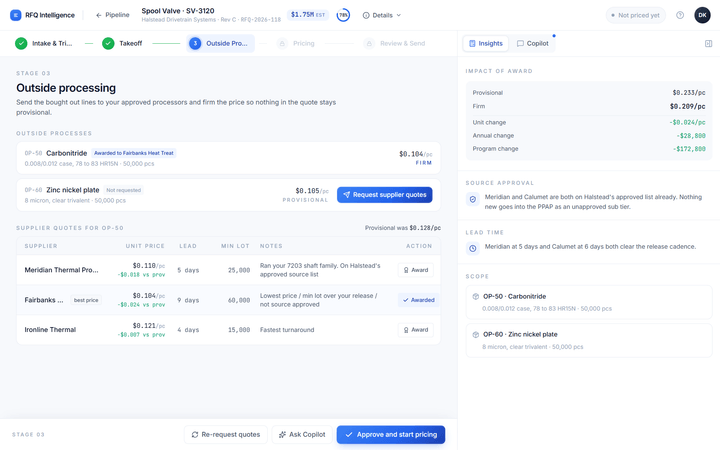
Every floor quotes differently, so the work after the pilot is configuration on your data. It takes 7 to 10 working days.
Job history
Your closed quotes and completed jobs, loaded and indexed
Work centers
Your machines, burdened rates and routing conventions
Operations
The way your estimators name and sequence the work
Outside processing
Your approved processors and their real lead times
Customer forms
Your customers' own quote formats, rendered and filled
ERP
Connected for live material and stock
Approvals
Your margin policy and who signs at which stage
For operations quoting 10 to 300 requests a month against customer prints.
Stage 01
No cost
One part, your history, a real package.
Stage 02
Where most floors start
One-time setup
7 to 10 working days configuring it on your data.
Everything in the pilot, plus
Stage 03
Monthly retainer
The system, the people, and the changes as they come.
Everything in the build, plus
As accurate as your own history, because that is the only thing it prices from. It reasons the way your best estimator does and sharpens with every job you close.
A vector PDF gives geometry directly, a scanned sheet is located and read with vision, and a 3D model gives a richer path when one exists. It was designed around the messy package rather than the ideal one.
7 to 10 working days after the pilot. The product is already built.
No. It reads live material, stock and work-center data from whatever you run.
It stays yours. Redact what you want before upload and work through a secure portal.
Your estimator, at all 5 stages. Nothing goes out without a person approving it.
Bring what you have. Most floors think theirs is worse than it is, and 500 closed jobs in a spreadsheet is plenty to start. The pilot tells you where you stand before you spend anything.
They price from geometry and a cost model. This prices from what your own jobs actually cost, and it reads the package the way it arrives.